Mary Zaarour has spent five decades in the same school in Rusaifa, teaching children the world had decided could not hear.
Careers are usually measured in posts held and titles gained. Hers is better measured in children: how many, over fifty years, walked into a classroom in Rusaifa unable to make themselves understood, and walked out of it able to.
Mary Zaarour came to Al-Rajaá School for the Deaf as a young teacher and never left. Governments changed. The city grew up around the school. Generations of pupils arrived small and frightened and left as adults with language. She stayed.
“Silence is a language of light.”
It is worth being precise about what she actually does, because the word “teacher” undersells it. Children arrive at Al-Rajaá with no shared language at all: not delayed language, none. What follows is slow and technical: sign language in both Arabic and English, speech therapy, auditory training, reading, writing, the patient business of learning to use hearing devices. Every one of those skills has to be built from nothing, in a child who cannot hear the teacher say the word.
Her colleagues quote her as saying that silence is a language of light. It sounds like a lovely phrase until you watch what it means in a classroom: that the absence of sound is not an absence of meaning, and that a child who cannot hear is not a child who cannot understand. Fifty years of working from that assumption is not sentiment. It is a stance, held daily, against a world inclined to assume the opposite.
There is a particular kind of institutional knowledge that cannot be written into a manual. Ms Zaarour knows which child is pretending to follow and which is genuinely lost. She knows how a family behaves in the first weeks after a diagnosis, and what to say to a mother who has just understood that her son will not hear her voice. She knows the small tricks of the hands that make an abstract idea land. None of this exists on paper. It exists in her, and in the teachers she has trained, and in the practice of a school that has kept going because she kept going.
Al-Rajaá is part of Johud's ecosystem, one of the institutions that gives the phrase “fifty years of community development” something you can actually stand inside. But an institution is only ever as durable as the people who refuse to leave it.
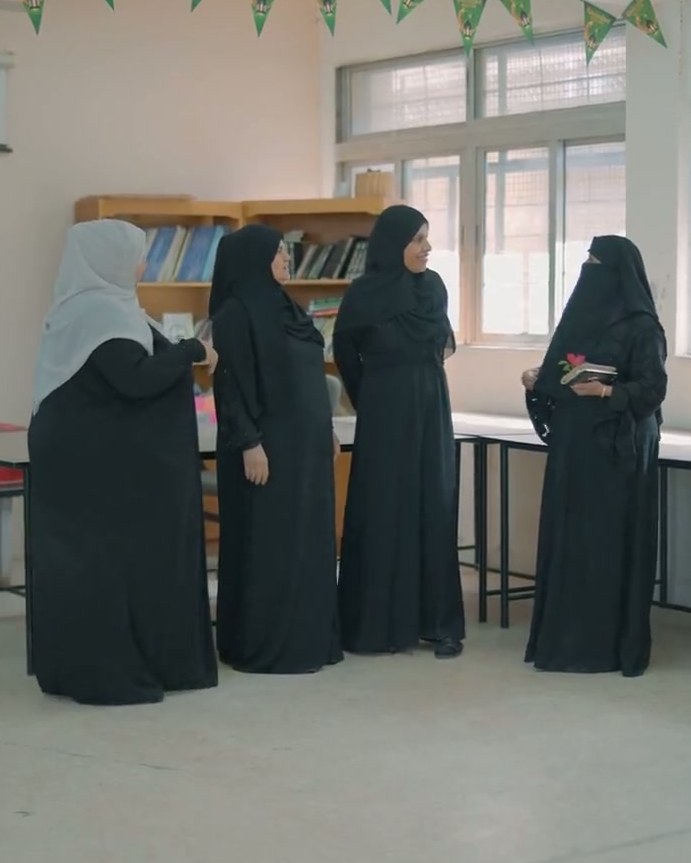
On Teachers' Day her school called her its heart. That is the correct word. A heart is not the most visible organ; it is simply the one that has to keep working, without pause, for everything else to function.
There is no dramatic turning point in this story, no before and after. That is the point of it. Some change arrives as a single event you can photograph. Some arrives as one woman going through the same gate, for fifty years, and doing the work.