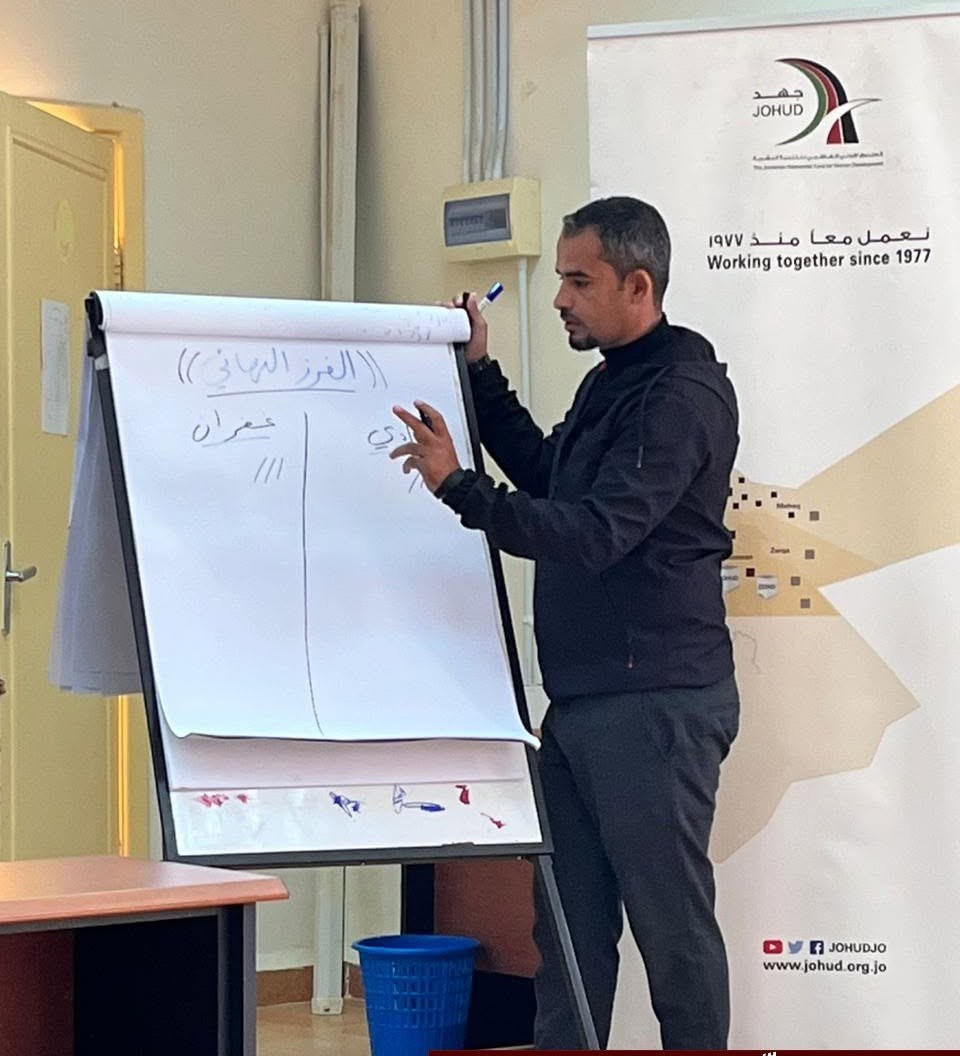
Abdullah Al-Saeedeen was a member of a Johud youth committee. He is now a member of the Wadi Araba municipal council.
Wadi Araba is about as far from the centre of Jordanian decision-making as it is possible to be and still be in Jordan. It is desert, sparsely populated, strung along the country's western edge, and it appears in national conversation mostly as a location rather than a constituency.
Which is what makes Abdullah Al-Saeedeen's election worth recording.
“The point of a youth committee is not to keep young people busy. It is to make them electable.”
He came up through a Johud youth committee, the same structure that runs in centres across all twelve governorates, and whose ordinary business is training, initiatives and the slow accumulation of the skills that let a young person speak in public without losing the thread.
He then stood for the Wadi Araba municipal council, and was elected to it.
Municipal councils are the least glamorous tier of Jordanian government and, for a community like this one, the most consequential. They deal in roads, services, local budgets and the daily texture of whether a remote place functions. A council seat in Wadi Araba is not a stepping stone to somewhere else; it is the instrument by which this community's needs are argued for at all.
So the significant fact is not that a young man won an election. It is that a community at the geographic margin now has, in the room, someone trained in exactly the skills that room requires, and who is young enough to be there for a long time.
He was elected in the same cycle as Faisal Al-Mahamid in Ma'an, who took a seat on the governorate council. Two young men, from two of the most remote parts of the country, through the same committee structure, into two elected bodies.
That is not a coincidence and it is not luck. It is what happens when an organisation spends decades running youth committees in places the capital rarely visits, and waits.